Welcome to contact us: aaa888@zhongsheng1688.cn


Views: 0 Author: Site Editor Publish Time: 2025-10-20 Origin: Site

In the world of plastics manufacturing, creating hollow containers like bottles and jars requires precision, consistency, and efficiency. One of the most advanced methods for achieving this is the injection blow molding (IBM) process. This technique combines the precision of injection molding with the container-forming capabilities of blow molding to produce high-quality, finished products with minimal waste.
This guide will walk you through each stage of the injection blow molding process. You will learn how it works, what makes it different from other molding methods, and why it is the preferred choice for producing a wide range of containers. Whether you are a product designer, an engineer, or simply curious about manufacturing, this article will provide a clear understanding of this essential process.
Injection blow molding is a multi-stage manufacturing process used to create hollow plastic parts. Unlike other molding methods, IBM begins by injection molding a solid "preform," which looks like a test tube with a threaded neck. This preform is then heated and inflated with compressed air inside a mold cavity, forcing it to take the shape of the final container.
This process is highly valued for its ability to produce parts with exceptional accuracy, particularly in the neck and thread details. This precision makes it ideal for bottles and jars where a tight seal is critical, such as in the pharmaceutical, cosmetic, and healthcare industries. The result is a container with a smooth finish, uniform wall thickness, and no excess material to trim.
The injection blow molding process is a well-orchestrated sequence that typically unfolds across three main stations. A rotary table moves the preforms from one station to the next, ensuring a continuous and efficient production cycle.
The process begins at the injection station. Here, raw plastic resin, usually in the form of small pellets, is fed into an extruder. Inside the extruder barrel, a reciprocating screw melts, mixes, and conveys the plastic.
Once the molten plastic reaches the right temperature and consistency, it is injected under high pressure into a preform mold. This mold shapes the molten plastic around a core rod, forming a parison or preform. This preform has the finished neck and thread details of the final product, but its body is thick and test-tube-shaped. The precision of this injection stage is what guarantees the accurate and consistent neck finish on every container. After the injection, the mold opens, and the rotary table moves the preform and its core rod to the next station.
At the second station, the preform, still warm and pliable from the injection stage, is enclosed within a blow mold. This blow mold is shaped like the final container.
Once the blow mold is securely closed around the preform, compressed air is blown through a channel in the core rod. This air inflates the soft plastic, stretching it outwards until it presses against the cold walls of the blow mold cavity. The plastic rapidly cools as it makes contact with the mold, solidifying into the desired shape. The controlled temperature and pressure at this stage are crucial for achieving a uniform wall thickness and a blemish-free surface.
The final stop is the ejection station. After the blowing stage is complete, the blow mold opens, and the rotary table moves the newly formed container to this station.
Here, the finished part is stripped off the core rod by a mechanical ejector system. Because the injection blow molding process is so precise, there is no flash (excess plastic) to remove. The containers are fully finished and ready for packaging, printing, or filling. The core rods, now empty, rotate back to the first station to begin the cycle all over again. This three-stage cycle allows for continuous production, as all three stations operate simultaneously on different sets of preforms.
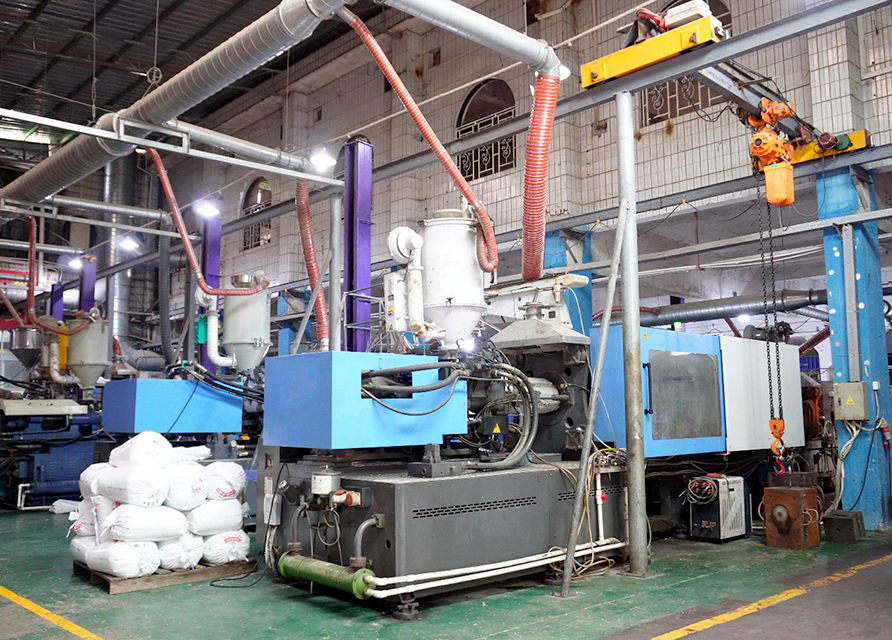
The choice of plastic resin is critical to the success of the injection blow molding process. Different materials offer unique properties suited for various applications. The most common materials include:
◆Polyethylene (PE): High-density polyethylene (HDPE) is widely used for its strength, chemical resistance, and cost-effectiveness. It's often found in bottles for milk, shampoo, and household cleaners. Low-density polyethylene (LDPE) is more flexible and is used for squeeze bottles.
◆Polypropylene (PP): Known for its excellent heat resistance and stiffness, PP is a popular choice for hot-fill applications, such as syrup bottles and pharmaceutical containers that require sterilization.
◆Polyethylene Terephthalate (PET): While more commonly associated with stretch blow molding, PET is sometimes used in IBM for its clarity, strength, and excellent barrier properties against gas and moisture. This makes it suitable for certain cosmetic and pharmaceutical packaging.
◆Polystyrene (PS): Polystyrene offers good clarity and stiffness, making it a good option for containers where appearance is important, such as vitamin jars and cosmetic pots.
Injection blow molding offers distinct benefits, but it also has limitations that make it more suitable for certain projects than others.
◆High Accuracy: The injection-molded neck provides exceptional dimensional precision for threads and sealing surfaces, ensuring a perfect fit for caps and closures.
◆No Scrap or Flash: The process is highly efficient and produces fully finished parts directly from the mold, eliminating the need for trimming and reducing material waste.
◆Uniform Wall Thickness: The controlled inflation of the preform leads to consistent wall thickness, improving the structural integrity and performance of the container.
◆Excellent Surface Finish: Containers produced via IBM have a high-quality, glossy finish without the seam lines common in other blow molding methods.
◆High Initial Tooling Cost: The complexity of the three-part tooling (injection mold, blow mold, and core rods) makes the initial investment significantly higher than for other molding processes.
◆Limited Part Design: The process is best suited for smaller, simpler containers. It is generally not used for bottles with handles or complex, irregular shapes.
◆Lower Production Rate for Large Parts: While efficient for small containers, the cycle time can be longer compared to extrusion blow molding, especially for larger items.
◆Material Constraints: The process works best with materials that have good melt flow characteristics, which can limit the range of usable resins.
The injection blow molding process stands out as a superior method for creating high-precision hollow plastic containers. Its ability to produce flash-free parts with accurate necks and uniform walls makes it an invaluable technique for industries where quality and consistency are non-negotiable. While the initial investment in tooling is high, the long-term benefits of reduced material waste, superior product quality, and high-volume efficiency often provide a strong return.
By understanding the distinct stages of injection, blowing, and ejection, you can better appreciate the engineering that goes into the bottles and jars you use every day. If your project demands precision and a premium finish, injection blow molding may be the ideal solution to bring your product to life.


