Welcome to contact us: aaa888@zhongsheng1688.cn


Views: 0 Author: Site Editor Publish Time: 2025-11-10 Origin: Site

Finding the right bottle container for your home can feel surprisingly complicated. Walk down any aisle in a home goods store, and you'll see shelves packed with options in every shape, size, and material. From storing your homemade salad dressing to keeping your shampoo organized, the right container makes a big difference. But how do you choose?
This guide will walk you through everything you need to consider when selecting bottle containers for your home. We'll explore different materials, focusing on the popular plastic bottle container, and examine key features that impact functionality and safety. By the end, you'll be equipped with the knowledge to make an informed choice that suits your lifestyle, your family's needs, and your home's aesthetic.
Choosing a bottle container isn't just about finding something to hold a liquid. The right choice can improve your daily routines, ensure your family's safety, and even contribute to a more sustainable lifestyle.
◆Safety and Health: Certain materials are better suited for food and drink, while others are designed for household chemicals. Using the wrong type of plastic, for example, could lead to harmful chemicals leaching into your food.
◆Durability and Longevity: A well-chosen container will withstand daily use, resist cracking or leaking, and last for years. This saves you money and reduces waste.
◆Convenience and Functionality: Features like an easy-to-use dispenser, a leak-proof seal, and a shape that fits your storage space can simplify your life.
◆Environmental Impact: Reusable containers are a fantastic way to reduce single-use plastic waste. Understanding which materials are recyclable and sustainably produced helps you make a more eco-conscious decision.
Bottle containers are made from a variety of materials, each with its own set of advantages and disadvantages. The most common options are plastic, glass, and metal.
Plastic is by far the most common material for bottle containers, and for good reason. It's lightweight, durable, and generally inexpensive. However, not all plastics are created equal. You can usually identify the type of plastic by the number inside the recycling symbol, known as the Resin Identification Code (RIC).
◆PET or PETE (1): Polyethylene terephthalate is one of the most common plastics. It's clear, lightweight, and shatter-resistant. You'll find it used for water bottles, soda bottles, and food jars (like peanut butter). It's highly recyclable but is best suited for single-use or limited reuse, as it can break down over time.
◆HDPE (2): High-density polyethylene is a sturdier, opaque plastic. It's used for milk jugs, juice bottles, and household cleaner containers. HDPE is very durable and considered safe for food and drink. It's also widely recycled.
◆PP (5): Polypropylene is a tough, heat-resistant plastic. This makes it ideal for containers that need to hold hot liquids or be microwaved, like reusable food containers and some baby bottles. It's also recyclable, though less commonly than PET and HDPE.
When selecting a plastic bottle container, look for options labeled "BPA-free." Bisphenol A (BPA) is a chemical that was once common in plastics, but research has linked it to potential health concerns. Most manufacturers have phased it out of food and beverage containers.
Glass is a fantastic choice for food and beverage storage. It's non-porous, so it won't absorb flavors, odors, or colors from its contents. It's also completely inert, meaning it won't leach any chemicals into your food.
Pros:
◆Non-toxic and free of chemicals
◆Easy to clean and sterilize
◆Doesn't stain or retain odors
◆Infinitely recyclable without loss of quality
Cons:
◆Heavy and breakable
◆Can be more expensive than plastic
Glass is perfect for storing pantry staples like oils and vinegars, homemade sauces, and fermented foods like kombucha.
Stainless steel and aluminum are the most common metals used for bottle containers. They are incredibly durable, lightweight, and offer excellent protection from light, which can degrade certain products.
Pros:
◆Extremely durable and long-lasting
◆Lightweight (especially aluminum)
◆Blocks out light, preserving contents
◆Recyclable
Cons:
◆Can sometimes impart a metallic taste
◆Not suitable for microwaves
◆Can be dented if dropped
Stainless steel water bottles are a popular choice for their durability and temperature-retention properties. Aluminum is often used for cosmetic and personal care product bottles.
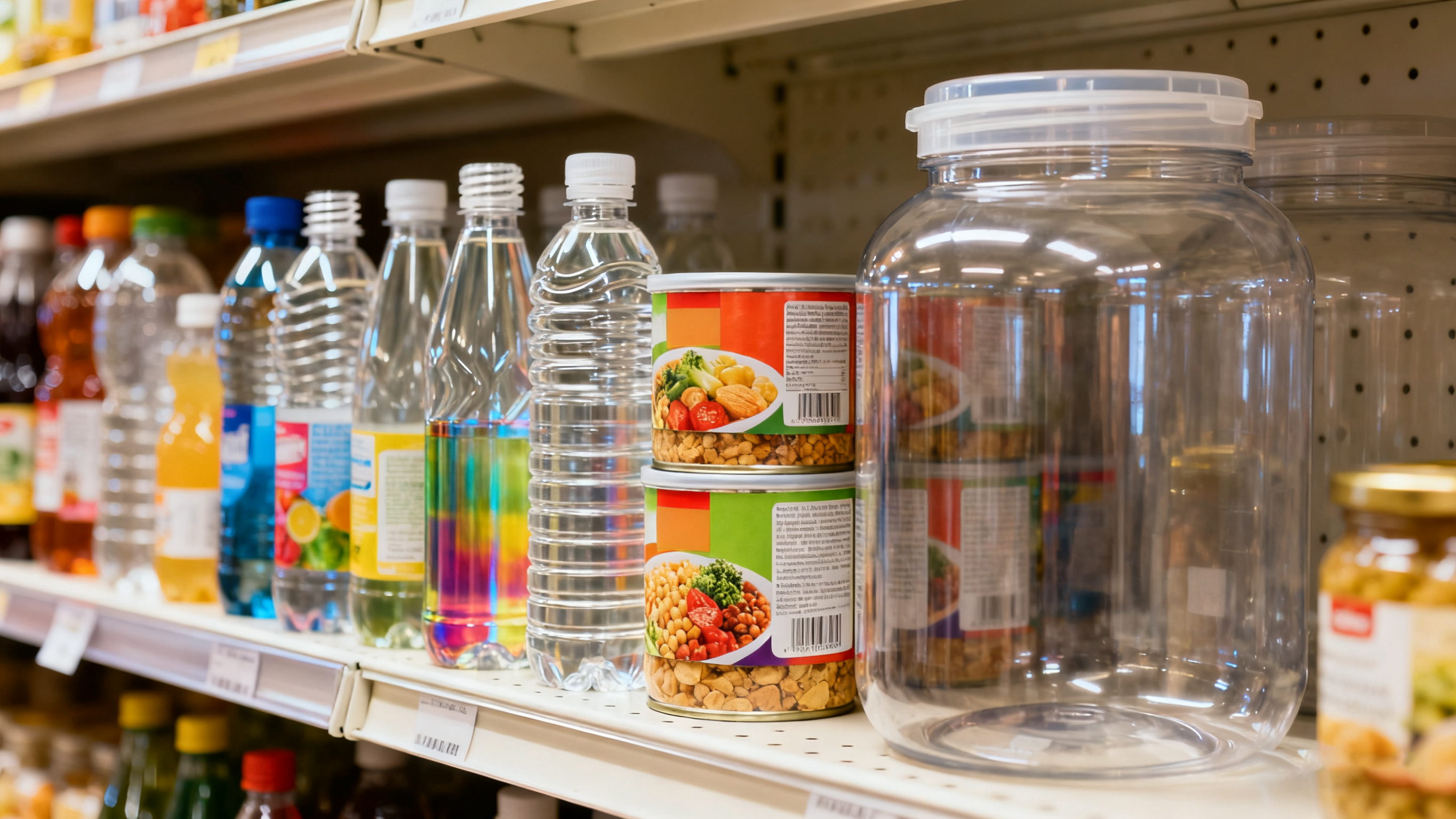
To help you decide, here is a quick comparison of the most common bottle container materials.
Feature | Plastic (HDPE, PP) | Glass | Stainless Steel |
|---|---|---|---|
Durability | Good to Excellent (shatter-resistant) | Poor (breakable) | Excellent (dent-resistant) |
Weight | Lightweight | Heavy | Moderate |
Heat Resistance | Varies (PP is good) | Excellent | Excellent |
Chemical Leaching | Low risk (BPA-free) | None | None |
Odor/Stain Resistance | Fair to Good | Excellent | Excellent |
Recyclability | Good (check local rules) | Excellent | Excellent |
Cost | Low | Moderate | High |
Best For | Household cleaners, pantry storage, personal care | Food/beverage, oils, sauces, fermented foods | Water bottles, travel mugs, light-sensitive liquids |
Beyond the material, several design features can make a bottle container more useful.
The closure is one of the most important parts of a bottle. A poorly designed lid can lead to frustrating leaks and spills.
◆Screw-top lids are common and create a tight seal, making them great for liquids you'll be transporting.
◆Flip-top lids offer convenient, one-handed access, which is ideal for water bottles or shampoo containers in the shower.
◆Pump dispensers are perfect for lotions, soaps, and condiments like ketchup or syrup.
◆Spray nozzles are necessary for cleaning solutions or cooking oils.
Always check that the seal is made from a food-grade material like silicone if you plan to use the container for anything edible.
Consider where and how you'll be using the bottle.
◆Wide-mouth openings make bottles easier to fill and clean. This is especially helpful for thick liquids, powders, or if you want to add ice cubes.
◆Slim, tall designs are space-efficient and fit well in refrigerator doors or car cup holders.
◆Square or rectangular shapes can be more space-efficient for pantry organization than round bottles.
If you plan to reuse your containers, they need to be easy to clean. Look for bottles that are dishwasher-safe. If hand-washing, a wide mouth is essential for getting a bottle brush inside. Avoid bottles with complex shapes or small crevices where bacteria can hide.
For cooking, meal prep, or mixing formulas, bottles with clear, embossed measurement markings are incredibly useful. They eliminate the need for extra measuring cups and help you get your quantities just right.
Choosing the perfect bottle container doesn't have to be overwhelming. By understanding the materials, identifying the key features you need, and thinking about how you'll use the item, you can confidently select a product that is safe, convenient, and built to last. Whether you opt for a versatile plastic bottle container for your cleaning supplies or an elegant glass bottle for your homemade vanilla extract, the right choice will make your home more organized and efficient.


